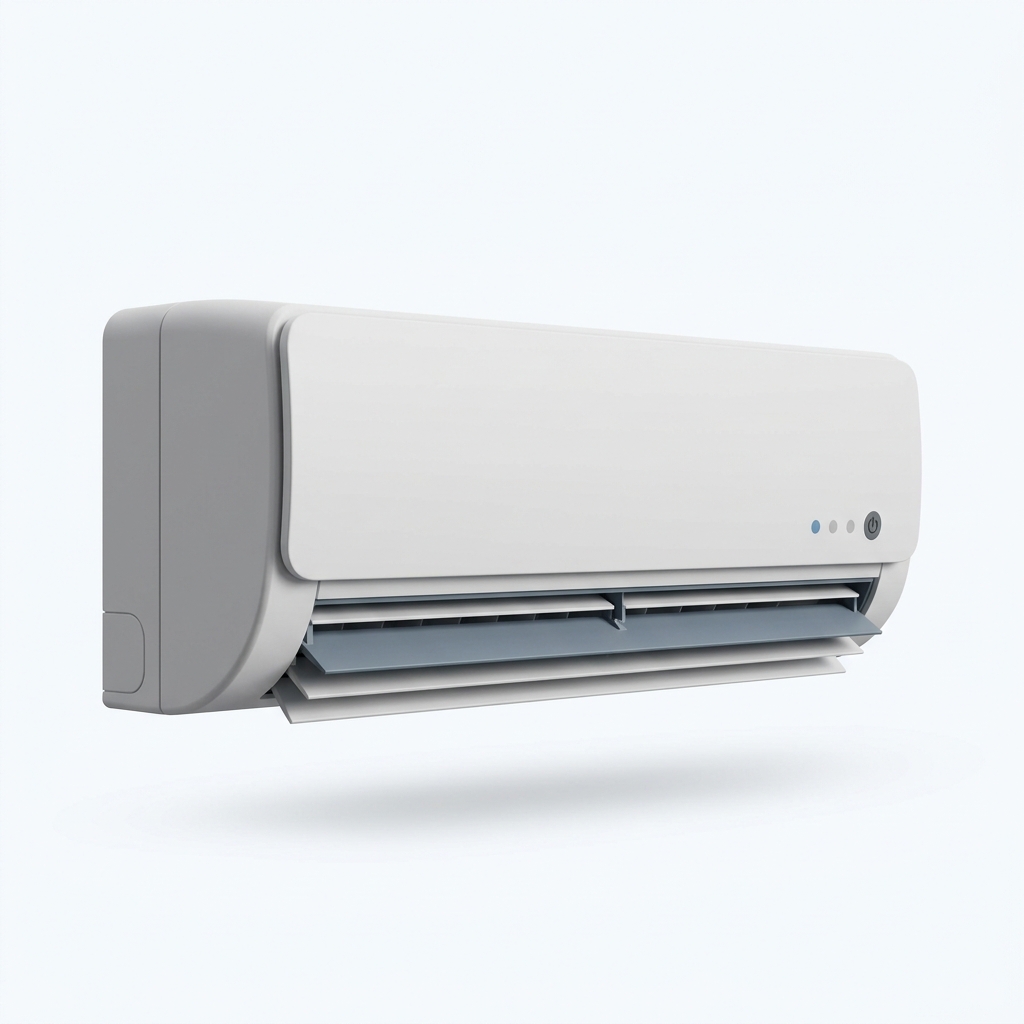
E1
How to Fix Carrier Air Conditioner Error E1
Error E1 on a Carrier split air conditioner signals a fault with the indoor ambient temperature sensor (thermistor). This sensor sits in the return air path of the indoor unit and feeds the PCB with real-time room temperature readings used to govern compressor speed and cooling cycles. When E1 triggers, the PCB loses room temperature data and either halts operation or runs a fixed default cycle, causing over-cooling or inadequate cooling.
Updated June 2026 · Cross-referenced with Carrier service manual
Indian context
Carrier E1 errors are most frequently reported during and immediately after the Indian monsoon season, when high humidity accelerates corrosion at the sensor connector inside the indoor unit. Cities with coastal exposure — Mumbai, Chennai, Kochi, Vizag — see disproportionately high E1 incident rates due to salt air compounding the humidity effect. In North Indian cities like Delhi, Lucknow, and Kanpur, voltage instability and summer load-shedding cause transient PCB glitches that trigger E1 without any physical sensor fault, making a simple MCB reset the first and most effective fix. Carrier India operates an authorised service network covering all metros and most tier-2 cities; service can be booked via the Carrier Home app or the 1800-103-3333 toll-free number. Repair cost (₹1300–₹1900) is competitive with comparable Voltas and Daikin sensor repairs. Hard water scale build-up on the indoor heat exchanger can indirectly raise sensor readings in hard-water zones like Rajasthan and parts of Punjab — annual AC servicing prevents this.
What error E1 means
Error E1 on a Carrier split air conditioner signals a fault with the indoor ambient temperature sensor (thermistor). This sensor sits in the return air path of the indoor unit and feeds the PCB with real-time room temperature readings used to govern compressor speed and cooling cycles. When E1 triggers, the PCB loses room temperature data and either halts operation or runs a fixed default cycle, causing over-cooling or inadequate cooling.
Why error E1 happens on a Carrier Air Conditioner
On a Carrier Air Conditioner, error E1typically resolves to one of three root-cause categories. They’re ordered cheapest-to-verify first — start at the top and only escalate if the first cause is ruled out.
- Mechanical: blockage, obstruction, or worn moving part. A common cause across Carrier Air Conditioners in India — air filters clog and fan bearings and drain lines collect dust and sludge. Our step-by-step fix below targets this category first because it’s the cheapest to verify and resolvereports.
- Electrical: voltage spike, sensor fault, or PCB anomaly. India’s grid carries more voltage fluctuation than many appliance design tolerances assume, and a routine surge or sag can be enough to throw E1. If you’ve had recent voltage events (lights flickering, AC tripping), start your investigation here. A working stabilizer prevents this entire category.
- Software / configuration: stuck child-lock, demo-mode, or pending firmware reset.Less common but the cheapest fix when it applies — a 60-second factory reset clears it. We list this last because it’s rarely the actual cause, but check it before disassembling anything.
Safety first
Step-by-step fix
- 1
Step 1
Hard reset at the MCB
Press the remote Off button, walk to the main electrical board and flip the AC's dedicated MCB or plug switch off. Wait a full 5 minutes — not less — for the PCB capacitors to discharge. Restore power, then turn on the AC from the remote. Monitor for 60 minutes. If E1 does not return, the error was caused by a temporary PCB glitch or a brief voltage spike, which are common during load-shedding in Delhi NCR, Maharashtra, and West Bengal.
- 2
Step 2
Verify room temperature accuracy
Place a standalone thermometer near the indoor unit intake grille (avoid direct sunlight or windows). Compare the reading with the room temperature displayed on your Carrier remote or PCB panel. A healthy sensor matches within 1°C. A large discrepancy — or a frozen or wildly incorrect reading — confirms the sensor has drifted out of calibration or failed completely.
- 3
Step 3
Access the indoor unit and locate the sensor
Switch off the MCB. Lift and remove the front panel cover of the indoor unit — on most Carrier Emperia and Ester models this means pushing in the two side tabs and hinging the panel upward. Remove the air filters. The indoor ambient sensor is a small capsule thermistor, usually dark green or black, clipped onto the return air grille frame with a 2-wire harness running to the main PCB. It should be free in the airstream, not touching metal or insulation.
- 4
Step 4
Inspect and reseat the sensor connector
Trace the sensor wire to the PCB connector (usually a white 2-pin JST plug). Disconnect it, inspect the pins for corrosion, dust, or ant damage — common inside Indian homes during summer months. Clean pins gently with a dry cotton swab or a short burst of electrical contact cleaner spray (₹450). Reseat the connector firmly until the locking tab clicks. Restore power and test. In many cases this alone clears E1 caused by a loose connection.
- 5
Step 5
Test the sensor resistance with a multimeter
With MCB off, disconnect the sensor's 2-pin connector from the PCB. Set a multimeter to resistance (Ohms) mode. Touch one probe to each sensor pin. At typical Indian room temperature of 25°C–32°C, a healthy Carrier indoor ambient sensor reads 5 kΩ to 15 kΩ. A reading of OL (open circuit, infinite) means the sensor is broken internally and must be replaced. A reading near 0 Ω (short circuit) also indicates a failed sensor.
- 6
Step 6
Book Carrier authorised service
If E1 persists after reset, reseating, and the multimeter test confirms a failed sensor, contact Carrier India customer care at 1800-103-3333 (toll-free). Carrier's authorised service engineers carry standard thermistor stock for most models. Expect a home visit fee of ₹500–₹700, sensor part cost of ₹400–₹700, and labour of ₹400–₹500. Total repair cost ₹1300–₹1900 with a 90-day parts warranty.
When to call a technician
- • E1 returns within 1 hour of every hard reset, indicating the sensor has failed permanently.
- • Multimeter confirms open circuit (OL) or short circuit (0 Ω) at the sensor pins.
- • Visible physical damage to sensor wire — rodent bites, pinching, or burnt insulation.
- • Your AC is still under Carrier warranty and you want the repair covered — any DIY disassembly may void the claim.
Fixed it? Protect it next time. See an extended warranty plan for your Air Conditioner →
Common mistakes Carrier Air Conditioner owners make with error E1
These six anti-patterns turn a routine 30-minute fix into a costly repair or warranty void. Read before starting.
- Forcing a stuck door, lid, or panel. Prising open a Carrier Air Conditioner housing while it is in a fault state. Forcing it usually breaks the latch or sensor — turning a small part replacement into a full service call. If the door won’t open, run the safety-disconnect step first, then try again.
- Repeated unplug-and-replug as a “reset” ritual. Cycling power three or four times without diagnosing the underlying cause stresses the PCB and can convert a soft fault into a permanent firmware-corruption code. Reset once, observe whether the error returns immediately, then move to actual diagnosis if it does.
- Pouring water (or any liquid) into electronics-adjacent areas to flush a blockage.Even a small amount near the PCB or main wiring harness can cause permanent damage that voids warranty. The unit’s drainage paths exist for a reason; if a blockage isn’t cleared by the manual procedure, it isn’t getting cleared by improvisation either.
- Skipping the safety-disconnect step.“I’ll just check quickly” is the most expensive sentence in appliance repair. Working live on a 230V circuit (especially with a hot or wet appliance) carries real shock risk and instantly voids any warranty claim. Disconnect, wait two minutes for capacitor drain, then proceed.
- Buying counterfeit replacement parts on Amazon.in. Red flags: price below 60% of Carrier authorised price, generic packaging without a model-compatibility list, seller name that doesn’t match a known Carrier parts distributor, listings dated within the last 30 days with no reviews. Counterfeit parts often work for 2-3 weeks then fail with a different error, costing you double.
- Calling an “independent” technician for a warranty-covered unit. Indian appliances under Carrier warranty must be serviced by authorised technicians or the warranty voids permanently. Even if the warranty is expired, third-party local technicians often replace working parts to inflate the bill — verify each part swap by asking to see the failure on the old part before they install the new one.
Preventing future E1 on your Carrier Air Conditioner
The fix above resolves the current instance. These five maintenance habits prevent it from coming back, specific to Carrier Air Conditioners in Indian operating conditions (hard water, voltage variability, monsoon humidity).
- Monthly: wash the air filters and clear the drain line. Hard-water deposits and everyday debris are a frequent cause of recurring E1 in India, and a few minutes each month is the cheapest way to avoid a repeat.
- Quarterly: descale water-touching components. Use food-grade citric acid or a Carrier approved descaler for hard-water regions (Bangalore, Hyderabad, large parts of Maharashtra and Tamil Nadu). Skipping this in a hard-water zone shortens the life of the heating and water-touching parts.
- Run the unit through a working stabilizer. A mainline stabilizer sized for Air Conditioners is the cheapest protection against voltage-induced E1 occurrences. The MCB on your distribution board is not a substitute — it trips on overload, not on under-voltage or surge.
- Decide AMC vs DIY honestly. Compare the CarrierAMC quote against what you have actually spent on service. If your unit is >5 years old and you’ve had two service calls in the last 18 months, an AMC usually pays for itself. Younger units with no service history: DIY plus stabilizer is cheaper.
- Watch monthly for early-warning signs. Unusual noise during a specific cycle phase, water spotting, mild burning smell — any of these means a service call within a week, not a wait-and-see month. Catching E1-precursor symptoms early turns a major repair into a routine maintenance visit.
If error E1 returns within 30 days of completing the fix above, escalate directly to Carrierauthorised service — repeat patterns within a month indicate a deeper fault (worn bearing, failing PCB, leak that wasn’t fully identified) that surface-level repair won’t resolve. Document the dates and circumstances of each occurrence; the service centre will use this to prioritize root-cause investigation.
Frequently asked questions
What exactly does the indoor ambient sensor do on a Carrier AC?
The indoor ambient temperature sensor continuously measures the actual room temperature and feeds that data to the PCB. The PCB compares it to your set temperature and adjusts compressor speed, fan speed, and cooling cycle duration accordingly. Without this reading, the AC cannot regulate cooling intelligently and either defaults to a fixed cycle or shuts down to prevent incorrect operation.
Can I run my Carrier AC while E1 is showing?
Some Carrier models fall back to a fixed compressor cycle when E1 is active, so you may feel cooling — but it is unregulated. The compressor runs at a fixed duty cycle regardless of actual room temperature, which can over-cool the room in mild weather or under-cool on a 45°C Delhi afternoon. Energy consumption rises 15–25%. Avoid running the AC in this state for more than 24–48 hours.
Why does E1 appear more during monsoon in India?
Humidity levels above 85% — typical in Mumbai, Kolkata, Chennai during June–September — allow moisture to seep into the indoor unit's electronics bay. Condensation forms on PCB connector pins and corrodes the sensor connection over time. Running your AC regularly during monsoon (rather than letting it sit idle for weeks) reduces this risk because the unit's own dehumidification cycle keeps the internals drier.
How much does Carrier E1 repair cost in India?
Carrier India authorised home visit: ₹500–₹700. Replacement indoor ambient sensor: ₹400–₹700. Labour: ₹400–₹500. Total: ₹1300–₹1900 with 90-day parts warranty. Grey market sensors at electronics markets in Chandni Chowk, Lamington Road, or SP Road cost ₹150–₹300 but often fail within 8–12 months. For units over 5 years old approaching compressor-overhaul age, weigh repair cost against replacement value.
Is Carrier E1 the same as Voltas E1 or LG CH 05?
No. Error codes are brand-specific. Carrier E1 = indoor ambient sensor fault. Voltas E1 = same general meaning but tied to Voltas PCB logic. LG CH 05 = room thermistor. Samsung E1 and Daikin errors use entirely different code schemes. Always confirm the brand and model before applying any troubleshooting guide.
People also ask
What does E1 mean on a Carrier Air Conditioner?
Can I fix Carrier Air Conditioner E1 error myself?
Why does my Carrier Air Conditioner show E1?
How do I quickly fix E1 on my Carrier Air Conditioner?
Related repair guides
Editor’s take
Carrier's E1 error code is one of the cleaner diagnostic signals in the Indian AC market — it points unambiguously to the indoor ambient temperature sensor, which is a low-cost component with a well-understood failure profile. What we find notable about Carrier's implementation compared to some competitor brands is that E1 is isolated specifically to the ambient sensor, while the evaporator sensor gets its own distinct code (E2). This separation makes diagnosis faster: if you see E1, you do not need to guess which sensor is involved. In practice, the most common cause in Indian field conditions is not the sensor itself but the connector to the PCB — humidity and thermal cycling gradually oxidize the 2-pin JST plug, raising resistance until the PCB reads the sensor as open-circuit and throws E1. The reseating step in this guide has resolved E1 without any parts replacement in a meaningful number of cases across high-humidity coastal installations. This is worth trying before ordering a replacement sensor. The harder question is economic: Carrier ACs over 6–7 years old showing E1 are often approaching their compressor's effective service life. A sensor replacement at ₹1300–₹1900 makes financial sense if the compressor and refrigerant circuit are healthy, but not if the unit will need a ₹6000–₹10000 compressor overhaul within the next 18 months. Ask the technician to assess compressor health during the E1 service visit. That single check changes the repair-vs-replace calculus significantly. For units under 4 years old, fix it — Carrier sensors are reliable once replaced and typically last another 5–6 years.
Same problem on other air conditioner brands
Error E1 on a Carrier air conditioner is a not cooling. Other brands show the same fault under a different code — the diagnosis is similar:
Blue Star — Error E1 on a Blue Star split air conditioner signals a fault in the indoor air temperature sensor (thermistor)
Air Conditioner
Blue Star — Error E2 on a Blue Star split air conditioner indicates a fault in the indoor evaporator coil temperature sensor
Air Conditioner
Blue Star — Error E3 on a Blue Star split air conditioner indicates a fault with the outdoor condenser coil temperature sensor
Air Conditioner
Blue Star — Error E5 on a Blue Star split air conditioner indicates that the compressor overcurrent protection circuit has tripped
Air Conditioner
Blue Star — Error F3 on a Blue Star split air conditioner indicates that the outdoor fan motor has failed or is not functioning within acceptable parameters
Air Conditioner
Daikin — Error A5 on a Daikin AC is a protection trip, not a broken part
Air Conditioner
Daikin — Error E5 on a Daikin AC indicates that the compressor's overload protection has activated
Air Conditioner
Daikin — Error E7 on a Daikin AC means the indoor unit's fan motor has stopped, stalled, or is not reaching the speed commanded by the PCB
Air Conditioner
All Carrier Air Conditioner error codes
Every Carrier air conditioner fault we cover. Browse the full Carrier air conditioner hub or all Carrier guides.