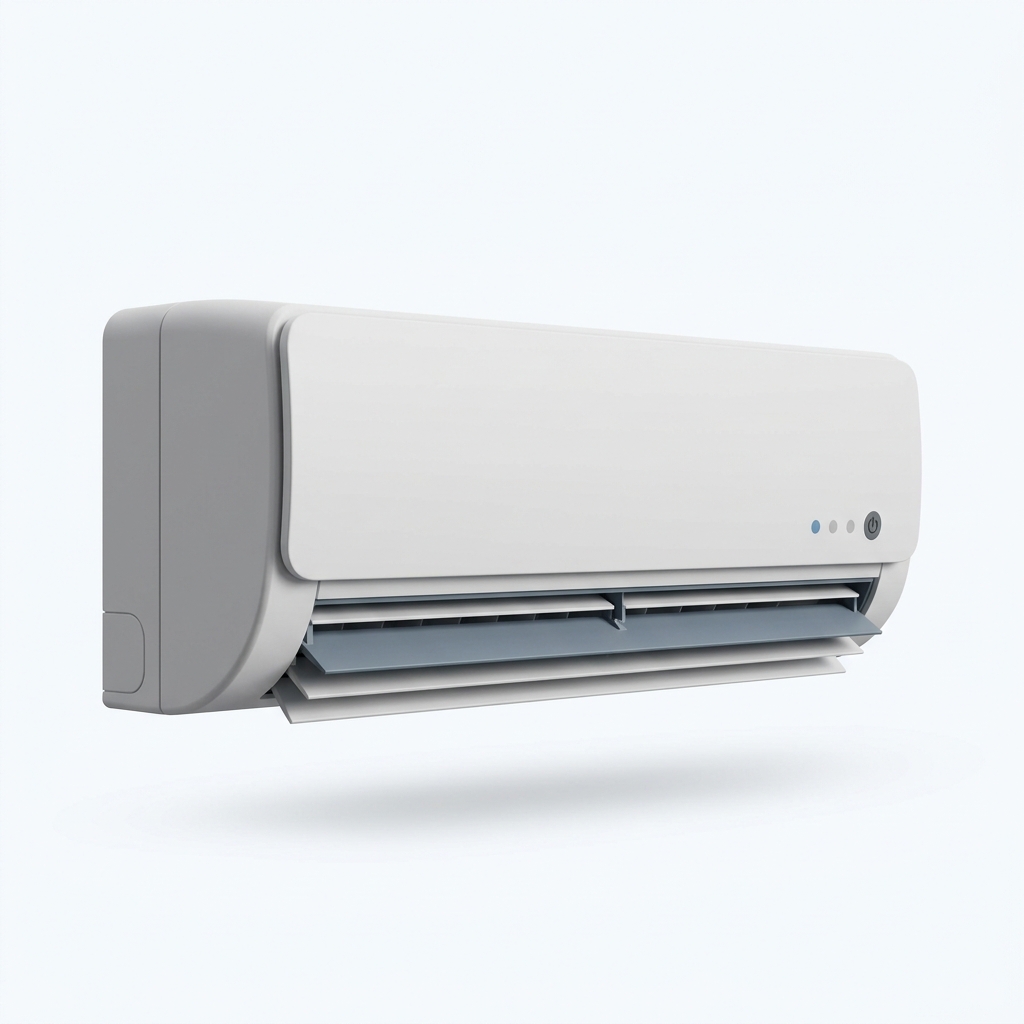
A5
How to Fix Daikin Air Conditioner Error A5
Error A5 on a Daikin AC is a protection trip, not a broken part. In cooling it is freeze-up protection — the indoor coil thermistor has seen the coil getting dangerously close to freezing, so the board pulls the compressor back to stop the coil icing over. (In heat-pump heating the same code covers high-pressure control.) The overwhelmingly common trigger in cooling is restricted airflow across the indoor coil: a dirty air filter, a dust-clogged evaporator coil, or a fan not moving enough air. Low refrigerant and a faulty indoor coil thermistor are the other, less common causes.
Updated July 2026 · Cross-referenced with Daikin service manual
Indian context
A5 is very common on Daikin units in India for one simple reason — dust. Filters clog fast in Indian conditions, especially during the pre-monsoon dust season across North India and in high-traffic urban areas, and a blanket of dust on the filter or coil chokes airflow and drops the coil temperature until A5 trips. Running the AC at very low set temperatures (18°C) for long hours through the night, common in Indian summers, makes freeze-ups more likely when airflow is already restricted. Daikin has a strong, well-regarded service and spares network in India (manufacturing at Neemrana, Rajasthan), so if the fault turns out to be refrigerant or a thermistor rather than simple cleaning, genuine service is readily available. The reassuring part: for most Indian households, A5 is solved with nothing more than filter and coil cleaning.
What error A5 means
Error A5 on a Daikin AC is a protection trip, not a broken part. In cooling it is freeze-up protection — the indoor coil thermistor has seen the coil getting dangerously close to freezing, so the board pulls the compressor back to stop the coil icing over. (In heat-pump heating the same code covers high-pressure control.) The overwhelmingly common trigger in cooling is restricted airflow across the indoor coil: a dirty air filter, a dust-clogged evaporator coil, or a fan not moving enough air. Low refrigerant and a faulty indoor coil thermistor are the other, less common causes.
Why error A5 happens on a Daikin Air Conditioner
On a Daikin Air Conditioner, error A5typically resolves to one of three root-cause categories. They’re ordered cheapest-to-verify first — start at the top and only escalate if the first cause is ruled out.
- Mechanical: blockage, obstruction, or worn moving part. A common cause across Daikin Air Conditioners in India — air filters clog and fan bearings and drain lines collect dust and sludge. Our step-by-step fix below targets this category first because it’s the cheapest to verify and resolvereports.
- Electrical: voltage spike, sensor fault, or PCB anomaly. India’s grid carries more voltage fluctuation than many appliance design tolerances assume, and a routine surge or sag can be enough to throw A5. If you’ve had recent voltage events (lights flickering, AC tripping), start your investigation here. A working stabilizer prevents this entire category.
- Software / configuration: stuck child-lock, demo-mode, or pending firmware reset.Less common but the cheapest fix when it applies — a 60-second factory reset clears it. We list this last because it’s rarely the actual cause, but check it before disassembling anything.
Safety first
Step-by-step fix
- 1
Step 1
Melt any ice first
If A5 tripped in cooling, the coil may be iced. Switch the AC off, or run it in FAN-only mode with cooling off, for 30–60 minutes so any ice on the indoor coil melts fully. Trying to inspect or run cooling with a frozen coil will just re-trip A5 and can drip water.
Pro tip: You may see water dripping from the indoor unit as ice melts — this is normal; keep a cloth handy under the unit.
- 2
Step 2
Clean the air filters
Lift the indoor unit's front panel, slide out both mesh air filters, and wash them under running water to remove all dust. Let them dry fully, then refit. Clogged filters are the single most common cause of A5 because they starve the coil of airflow and let it freeze.
Pro tip: In dusty Indian conditions, clean AC filters every 2–3 weeks during heavy use to prevent A5 recurring.
- 3
Step 3
Check the evaporator coil and airflow
With power off at the MCB, look at the aluminium evaporator coil behind the filters. If it is coated in dust or grime, gently clean it with a soft brush or a coil-cleaning spray made for AC evaporators, following the product instructions. Make sure nothing (furniture, curtains) is blocking the indoor unit's air intake or outlet.
Caution: Do not bend the thin aluminium fins and do not let cleaning liquid reach the PCB. Keep the MCB off while cleaning.
- 4
Step 4
Clean the outdoor unit and check the fan
A choked or hot outdoor condenser also stresses the system. With power off, clear leaves, dust and debris from the outdoor unit's coil and confirm its fan spins freely and nothing obstructs airflow around it. Confirm the indoor blower fan spins up normally when you restart.
Pro tip: Outdoor units on Indian terraces and balconies collect a lot of dust and bird debris — a quick clean improves heat rejection and reduces protection trips.
- 5
Step 5
Restart and monitor
Restore power, restart in cool mode at a moderate set point (24–26°C), and let it run 20–30 minutes. With airflow restored, A5 should not return and cooling should be steady. If A5 trips again quickly despite clean filters, a clean coil and good airflow, the likely cause is low refrigerant or a faulty coil thermistor — both need a technician.
Pro tip: Avoid immediately setting 18°C after a freeze-up; a moderate set point while you confirm the fix is more reliable.
When to call a technician
- • A5 keeps tripping even after you have washed the filters, cleaned the coil, and confirmed good airflow indoors and outdoors — the refrigerant charge or coil thermistor needs checking.
- • You suspect low refrigerant (weak cooling, ice forming on the outdoor pipes/valves) — refrigerant work is a sealed-system job for a licensed technician only, never a DIY task.
- • The indoor coil ices up again immediately even with clean filters and the fan clearly running.
- • You are not comfortable opening the indoor unit or the outdoor unit needs internal inspection.
Fixed it? Protect it next time. See an extended warranty plan for your Air Conditioner →
Common mistakes Daikin Air Conditioner owners make with error A5
These six anti-patterns turn a routine 30-minute fix into a costly repair or warranty void. Read before starting.
- Forcing a stuck door, lid, or panel. Prising open a Daikin Air Conditioner housing while it is in a fault state. Forcing it usually breaks the latch or sensor — turning a small part replacement into a full service call. If the door won’t open, run the safety-disconnect step first, then try again.
- Repeated unplug-and-replug as a “reset” ritual. Cycling power three or four times without diagnosing the underlying cause stresses the PCB and can convert a soft fault into a permanent firmware-corruption code. Reset once, observe whether the error returns immediately, then move to actual diagnosis if it does.
- Pouring water (or any liquid) into electronics-adjacent areas to flush a blockage.Even a small amount near the PCB or main wiring harness can cause permanent damage that voids warranty. The unit’s drainage paths exist for a reason; if a blockage isn’t cleared by the manual procedure, it isn’t getting cleared by improvisation either.
- Skipping the safety-disconnect step.“I’ll just check quickly” is the most expensive sentence in appliance repair. Working live on a 230V circuit (especially with a hot or wet appliance) carries real shock risk and instantly voids any warranty claim. Disconnect, wait two minutes for capacitor drain, then proceed.
- Buying counterfeit replacement parts on Amazon.in. Red flags: price below 60% of Daikin authorised price, generic packaging without a model-compatibility list, seller name that doesn’t match a known Daikin parts distributor, listings dated within the last 30 days with no reviews. Counterfeit parts often work for 2-3 weeks then fail with a different error, costing you double.
- Calling an “independent” technician for a warranty-covered unit. Indian appliances under Daikin warranty must be serviced by authorised technicians or the warranty voids permanently. Even if the warranty is expired, third-party local technicians often replace working parts to inflate the bill — verify each part swap by asking to see the failure on the old part before they install the new one.
Preventing future A5 on your Daikin Air Conditioner
The fix above resolves the current instance. These five maintenance habits prevent it from coming back, specific to Daikin Air Conditioners in Indian operating conditions (hard water, voltage variability, monsoon humidity).
- Monthly: wash the air filters and clear the drain line. Hard-water deposits and everyday debris are a frequent cause of recurring A5 in India, and a few minutes each month is the cheapest way to avoid a repeat.
- Quarterly: descale water-touching components. Use food-grade citric acid or a Daikin approved descaler for hard-water regions (Bangalore, Hyderabad, large parts of Maharashtra and Tamil Nadu). Skipping this in a hard-water zone shortens the life of the heating and water-touching parts.
- Run the unit through a working stabilizer. A mainline stabilizer sized for Air Conditioners is the cheapest protection against voltage-induced A5 occurrences. The MCB on your distribution board is not a substitute — it trips on overload, not on under-voltage or surge.
- Decide AMC vs DIY honestly. Compare the DaikinAMC quote against what you have actually spent on service. If your unit is >5 years old and you’ve had two service calls in the last 18 months, an AMC usually pays for itself. Younger units with no service history: DIY plus stabilizer is cheaper.
- Watch monthly for early-warning signs. Unusual noise during a specific cycle phase, water spotting, mild burning smell — any of these means a service call within a week, not a wait-and-see month. Catching A5-precursor symptoms early turns a major repair into a routine maintenance visit.
If error A5 returns within 30 days of completing the fix above, escalate directly to Daikinauthorised service — repeat patterns within a month indicate a deeper fault (worn bearing, failing PCB, leak that wasn’t fully identified) that surface-level repair won’t resolve. Document the dates and circumstances of each occurrence; the service centre will use this to prioritize root-cause investigation.
Frequently asked questions
What does A5 mean on a Daikin AC?
A5 is a protection trip. In cooling it is freeze-up protection — the indoor coil is getting close to freezing, so the system throttles the compressor to prevent icing. In heat-pump heating the same code covers high-pressure control. The usual cause in cooling is restricted airflow from a dirty filter or coil.
Why does my Daikin AC keep freezing and showing A5?
Freeze-ups almost always come from poor airflow across the indoor coil. A dust-clogged filter or evaporator coil, a weak indoor fan, or running very low set temperatures for long periods all let the coil drop below freezing. Cleaning the filter and coil and restoring airflow resolves most cases. Persistent A5 can also mean low refrigerant.
Can I fix A5 myself?
Usually yes. Melting any ice, washing the filters, cleaning the coil, and clearing airflow blockages are safe, beginner-level tasks that fix the majority of A5 trips. If A5 returns quickly after a thorough clean, the remaining causes — low refrigerant or a faulty thermistor — need a qualified technician.
Does A5 mean my Daikin AC is low on gas?
Not necessarily, and usually not. Low refrigerant is only one of several causes and is not the most common. Clean the filter and coil and restore airflow first. Only if A5 keeps tripping with genuinely clean filters, a clean coil and good airflow should you have a technician check the refrigerant charge and the coil thermistor.
People also ask
How do I stop my Daikin AC coil from freezing?
Is it safe to run an AC showing A5?
How often should I clean my AC filter in India?
Related repair guides
Editor’s take
A5 is the Daikin code we most like to see, because nine times out of ten in Indian homes it is telling you the unit needs a clean, not a repair. It is a protection trip working exactly as designed — the AC noticed the indoor coil heading toward freezing and backed off to protect itself. The root cause is almost always airflow, and airflow in India means dust: filters and coils clog far faster here than the manuals assume. Before anyone talks about gas top-ups, wash the filters, clean the coil, clear the outdoor unit, and stop running the AC flat-out at 18°C. That sequence fixes the large majority of A5 complaints for the price of a coil-cleaner spray. The one honest caveat: A5 can also be an early warning of low refrigerant or a failing thermistor, and both of those are technician territory — refrigerant especially, because the sealed system should never be opened by a DIYer. So give the cleaning a genuine, thorough try; if A5 comes straight back on clean filters and a clean coil, that is your signal to call Daikin service rather than keep guessing.
Same problem on other air conditioner brands
Error A5 on a Daikin air conditioner is a not cooling. Other brands show the same fault under a different code — the diagnosis is similar:
Blue Star — Error E1 on a Blue Star split air conditioner signals a fault in the indoor air temperature sensor (thermistor)
Air Conditioner
Blue Star — Error E2 on a Blue Star split air conditioner indicates a fault in the indoor evaporator coil temperature sensor
Air Conditioner
Blue Star — Error E3 on a Blue Star split air conditioner indicates a fault with the outdoor condenser coil temperature sensor
Air Conditioner
Blue Star — Error E5 on a Blue Star split air conditioner indicates that the compressor overcurrent protection circuit has tripped
Air Conditioner
Blue Star — Error F3 on a Blue Star split air conditioner indicates that the outdoor fan motor has failed or is not functioning within acceptable parameters
Air Conditioner
Carrier — Error E1 on a Carrier split air conditioner signals a fault with the indoor ambient temperature sensor (thermistor)
Air Conditioner
Carrier — Error E2 on a Carrier split AC indicates a fault with the indoor evaporator (coil) temperature sensor
Air Conditioner
Carrier — Error E4 on a Carrier split air conditioner indicates a fault with the outdoor condenser temperature sensor
Air Conditioner