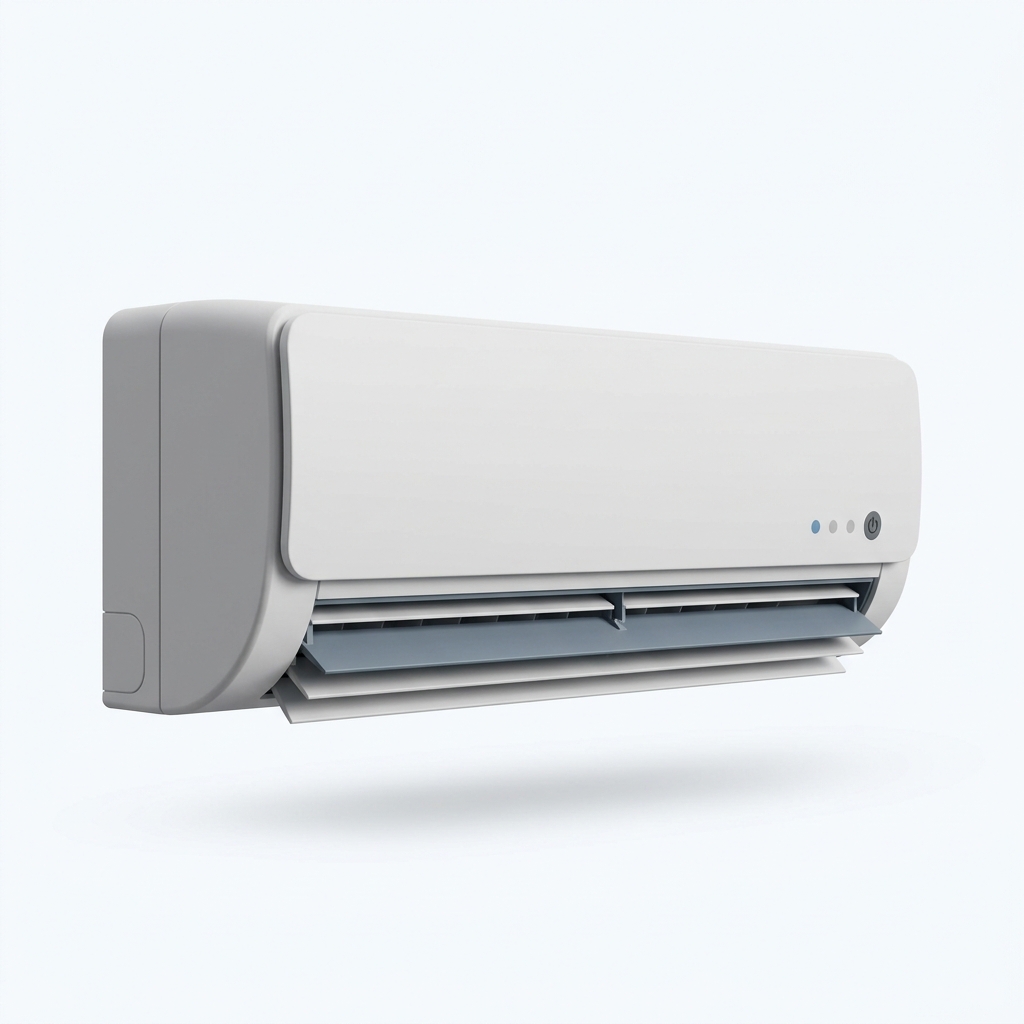
E7
How to Fix Daikin Air Conditioner Error E7
Error E7 on a Daikin AC means the indoor unit's fan motor has stopped, stalled, or is not reaching the speed commanded by the PCB. The AC shuts down because without airflow over the evaporator coil, the coil would freeze and damage the refrigerant system.
Updated June 2026 · Cross-referenced with Daikin service manual
Indian context
Daikin E7 fan motor faults are disproportionately common in Indian homes during the post-monsoon season (October-November) when mould and organic debris that accumulated inside the indoor unit during the monsoon dry out and form thick deposits on the fan scroll. Cities like Chennai, Hyderabad, and Kochi — which have extended humid seasons — see higher rates of E7 compared to drier regions. In Delhi and Jaipur, the opposite pattern holds: fine construction dust from ongoing city development clogs fan scrolls in 12-18 months, even with regular filter cleaning. A professional coil and fan wash at ₹800-1,200 every 18 months prevents the majority of E7 incidents. Hard water in cities like Bengaluru can also accelerate bearing corrosion if the AC is exposed to any water ingress — a growing concern with extreme rainfall events becoming more common across India.
What error E7 means
Error E7 on a Daikin AC means the indoor unit's fan motor has stopped, stalled, or is not reaching the speed commanded by the PCB. The AC shuts down because without airflow over the evaporator coil, the coil would freeze and damage the refrigerant system.
Why error E7 happens on a Daikin Air Conditioner
On a Daikin Air Conditioner, error E7typically resolves to one of three root-cause categories. They’re ordered cheapest-to-verify first — start at the top and only escalate if the first cause is ruled out.
- Mechanical: blockage, obstruction, or worn moving part. A common cause across Daikin Air Conditioners in India — air filters clog and fan bearings and drain lines collect dust and sludge. Our step-by-step fix below targets this category first because it’s the cheapest to verify and resolvereports.
- Electrical: voltage spike, sensor fault, or PCB anomaly. India’s grid carries more voltage fluctuation than many appliance design tolerances assume, and a routine surge or sag can be enough to throw E7. If you’ve had recent voltage events (lights flickering, AC tripping), start your investigation here. A working stabilizer prevents this entire category.
- Software / configuration: stuck child-lock, demo-mode, or pending firmware reset.Less common but the cheapest fix when it applies — a 60-second factory reset clears it. We list this last because it’s rarely the actual cause, but check it before disassembling anything.
Safety first
Step-by-step fix
- 1
Step 1
Power cycle the unit
Turn off the AC at the MCB and wait 5 minutes. Power it back on. Watch the indoor unit — you should hear the fan blades start spinning within 5-10 seconds of startup. If the fan does not spin, E7 will return immediately.
Pro tip: Listen carefully at startup. A clicking or grinding sound before the fan stalls indicates a physical obstruction or bearing failure, not a PCB fault.
- 2
Step 2
Check for obstructions in the fan
With the MCB off, open the indoor unit's front panel. Shine a torch into the fan barrel (the cylindrical fan visible behind the filters). Look for dust clumps, insects, a broken fan blade, or any foreign object that could prevent rotation. Rotate the fan barrel gently by hand — it should spin freely with very little resistance.
Pro tip: In Indian homes, dried insects (cockroaches especially) getting lodged in the fan scroll are a surprisingly common cause of E7. A blocked scroll creates enough drag to stall the motor under load.
- 3
Step 3
Clean the fan barrel
If the fan barrel is coated in thick dust (very common after 2+ years without servicing), use a long-bristle brush to clean between the blades. Thick dust buildup can add enough weight and drag to the fan that a borderline-healthy motor stalls. Reinstall the filter and try powering the unit.
Pro tip: A clean fan runs 8-12% more efficiently and significantly reduces E7 risk. In dusty cities like Delhi, Pune, and Ahmedabad, fan cleaning should be part of the annual AC service.
- 4
Step 4
Inspect the fan motor capacitor
The indoor fan motor is typically driven by a capacitor for both starting and running. With the MCB off, locate the small cylindrical capacitor on the PCB or connected directly to the fan motor (usually a 1-4 µF, 450V component). Check if the top is domed or bulging — a bulged capacitor has failed. A failed fan capacitor is the single most common cause of E7 after obstructions.
Pro tip: Fan capacitors cost ₹80-200 each. If you can identify the µF rating printed on the capacitor, take it to any electronics component shop — they are universally available.
- 5
Step 5
Check the fan motor connector at the PCB
Locate the 3-4 pin connector linking the fan motor wiring to the main PCB. Unplug it and inspect the pins for corrosion (green/white deposits) or bent pins. Plug it back in firmly. Loose motor connectors are common in older units that have experienced repeated vibration.
Pro tip: If you have a multimeter, switch to resistance mode and measure between the motor's winding pins — typical values are 10-100Ω for a healthy winding. An open circuit (infinite resistance) means the motor winding is burned out.
- 6
Step 6
Test for PCB fan control failure
If the motor spins freely by hand, the capacitor is good, and the connector is seated, the PCB fan driver circuit may have failed. This is confirmed when the fan does not spin at all even after a fresh power cycle. A technician can measure the PWM output signal from the PCB to the motor to confirm.
Pro tip: PCB fan driver failures are less common than motor or capacitor failures but more expensive to fix — a full PCB replacement is typically required rather than component-level repair.
When to call a technician
- • The fan barrel does not spin freely by hand — bearings may have seized
- • E7 returns immediately even after clearing the fan of obstructions
- • You smell burning when the fan attempts to start
- • The fan capacitor looks fine visually but E7 persists — motor winding resistance testing is needed
Fixed it? Protect it next time. See an extended warranty plan for your Air Conditioner →
Common mistakes Daikin Air Conditioner owners make with error E7
These six anti-patterns turn a routine 30-minute fix into a costly repair or warranty void. Read before starting.
- Forcing a stuck door, lid, or panel. Prising open a Daikin Air Conditioner housing while it is in a fault state. Forcing it usually breaks the latch or sensor — turning a small part replacement into a full service call. If the door won’t open, run the safety-disconnect step first, then try again.
- Repeated unplug-and-replug as a “reset” ritual. Cycling power three or four times without diagnosing the underlying cause stresses the PCB and can convert a soft fault into a permanent firmware-corruption code. Reset once, observe whether the error returns immediately, then move to actual diagnosis if it does.
- Pouring water (or any liquid) into electronics-adjacent areas to flush a blockage.Even a small amount near the PCB or main wiring harness can cause permanent damage that voids warranty. The unit’s drainage paths exist for a reason; if a blockage isn’t cleared by the manual procedure, it isn’t getting cleared by improvisation either.
- Skipping the safety-disconnect step.“I’ll just check quickly” is the most expensive sentence in appliance repair. Working live on a 230V circuit (especially with a hot or wet appliance) carries real shock risk and instantly voids any warranty claim. Disconnect, wait two minutes for capacitor drain, then proceed.
- Buying counterfeit replacement parts on Amazon.in. Red flags: price below 60% of Daikin authorised price, generic packaging without a model-compatibility list, seller name that doesn’t match a known Daikin parts distributor, listings dated within the last 30 days with no reviews. Counterfeit parts often work for 2-3 weeks then fail with a different error, costing you double.
- Calling an “independent” technician for a warranty-covered unit. Indian appliances under Daikin warranty must be serviced by authorised technicians or the warranty voids permanently. Even if the warranty is expired, third-party local technicians often replace working parts to inflate the bill — verify each part swap by asking to see the failure on the old part before they install the new one.
Preventing future E7 on your Daikin Air Conditioner
The fix above resolves the current instance. These five maintenance habits prevent it from coming back, specific to Daikin Air Conditioners in Indian operating conditions (hard water, voltage variability, monsoon humidity).
- Monthly: wash the air filters and clear the drain line. Hard-water deposits and everyday debris are a frequent cause of recurring E7 in India, and a few minutes each month is the cheapest way to avoid a repeat.
- Quarterly: descale water-touching components. Use food-grade citric acid or a Daikin approved descaler for hard-water regions (Bangalore, Hyderabad, large parts of Maharashtra and Tamil Nadu). Skipping this in a hard-water zone shortens the life of the heating and water-touching parts.
- Run the unit through a working stabilizer. A mainline stabilizer sized for Air Conditioners is the cheapest protection against voltage-induced E7 occurrences. The MCB on your distribution board is not a substitute — it trips on overload, not on under-voltage or surge.
- Decide AMC vs DIY honestly. Compare the DaikinAMC quote against what you have actually spent on service. If your unit is >5 years old and you’ve had two service calls in the last 18 months, an AMC usually pays for itself. Younger units with no service history: DIY plus stabilizer is cheaper.
- Watch monthly for early-warning signs. Unusual noise during a specific cycle phase, water spotting, mild burning smell — any of these means a service call within a week, not a wait-and-see month. Catching E7-precursor symptoms early turns a major repair into a routine maintenance visit.
If error E7 returns within 30 days of completing the fix above, escalate directly to Daikinauthorised service — repeat patterns within a month indicate a deeper fault (worn bearing, failing PCB, leak that wasn’t fully identified) that surface-level repair won’t resolve. Document the dates and circumstances of each occurrence; the service centre will use this to prioritize root-cause investigation.
Frequently asked questions
What does E7 mean on a Daikin air conditioner?
E7 indicates the indoor unit's fan motor has stalled or failed to reach the target speed. The most common causes are physical obstructions in the fan scroll, a failed run capacitor, or a burned-out motor winding.
Can I use the Daikin AC with a faulty indoor fan?
No. Running an AC without proper indoor fan operation causes the evaporator coil to ice up within minutes. Once iced, the refrigerant system can suffer liquid slugging damage that costs far more to repair than the fan motor itself.
How much does an indoor fan motor replacement cost for Daikin?
Daikin indoor fan motors cost ₹1,200-2,800 for the part, depending on the model, plus ₹500-800 for labour. Total repair cost is typically ₹1,700-3,600. If the unit is under 3 years old and under warranty, this is covered.
Why did my Daikin AC fan motor fail so quickly?
The main accelerators of fan motor failure in India are continuous dust accumulation (which insulates the motor windings, causing overheating), voltage fluctuations that stress the motor, and hard water mineral deposits from humid environments corroding bearings.
People also ask
What does E7 mean on a Daikin Air Conditioner?
Can I fix Daikin Air Conditioner E7 error myself?
Why does my Daikin Air Conditioner show E7?
How do I quickly fix E7 on my Daikin Air Conditioner?
Related repair guides
Editor’s take
Error E7 has a clear diagnostic hierarchy that is worth following methodically rather than jumping to motor replacement. Physical obstruction and a failed run capacitor together account for around half of E7 incidents. Both are low-cost fixes (free to ₹200) that any mechanically confident person can resolve without a technician. The fan motor capacitor is particularly worth inspecting early in the diagnostic process. Fan capacitors in Indian ACs are under significant stress: heat, humidity, and voltage transients age them faster than the motor itself. A capacitor that tests fine visually can still have lost enough capacitance to prevent the motor from starting reliably under load. If you have a multimeter with a capacitance function, a fan capacitor that reads more than 10% below its rated µF value should be replaced regardless of appearance. Motor winding failure is the more expensive scenario, but it is also more clear-cut diagnostically: the motor does not spin by hand when power is disconnected (seized bearings) or shows open-circuit resistance when tested with a multimeter. If you can confirm this before calling a technician, you can get an accurate repair quote upfront rather than paying a diagnostic fee. One India-specific note: Daikin's spare parts supply chain is generally reliable in tier-1 cities, but fans for older models (5+ years) can take 5-10 days to arrive in tier-2 and tier-3 cities. If you are in Nashik, Coimbatore, Bhubaneswar, or a similar city, factor this into your planning — you may be without cooling for over a week during peak summer.
Same problem on other air conditioner brands
Error E7 on a Daikin air conditioner is a not cooling. Other brands show the same fault under a different code — the diagnosis is similar:
Blue Star — Error E1 on a Blue Star split air conditioner signals a fault in the indoor air temperature sensor (thermistor)
Air Conditioner
Blue Star — Error E2 on a Blue Star split air conditioner indicates a fault in the indoor evaporator coil temperature sensor
Air Conditioner
Blue Star — Error E3 on a Blue Star split air conditioner indicates a fault with the outdoor condenser coil temperature sensor
Air Conditioner
Blue Star — Error E5 on a Blue Star split air conditioner indicates that the compressor overcurrent protection circuit has tripped
Air Conditioner
Blue Star — Error F3 on a Blue Star split air conditioner indicates that the outdoor fan motor has failed or is not functioning within acceptable parameters
Air Conditioner
Carrier — Error E1 on a Carrier split air conditioner signals a fault with the indoor ambient temperature sensor (thermistor)
Air Conditioner
Carrier — Error E2 on a Carrier split AC indicates a fault with the indoor evaporator (coil) temperature sensor
Air Conditioner
Carrier — Error E4 on a Carrier split air conditioner indicates a fault with the outdoor condenser temperature sensor
Air Conditioner