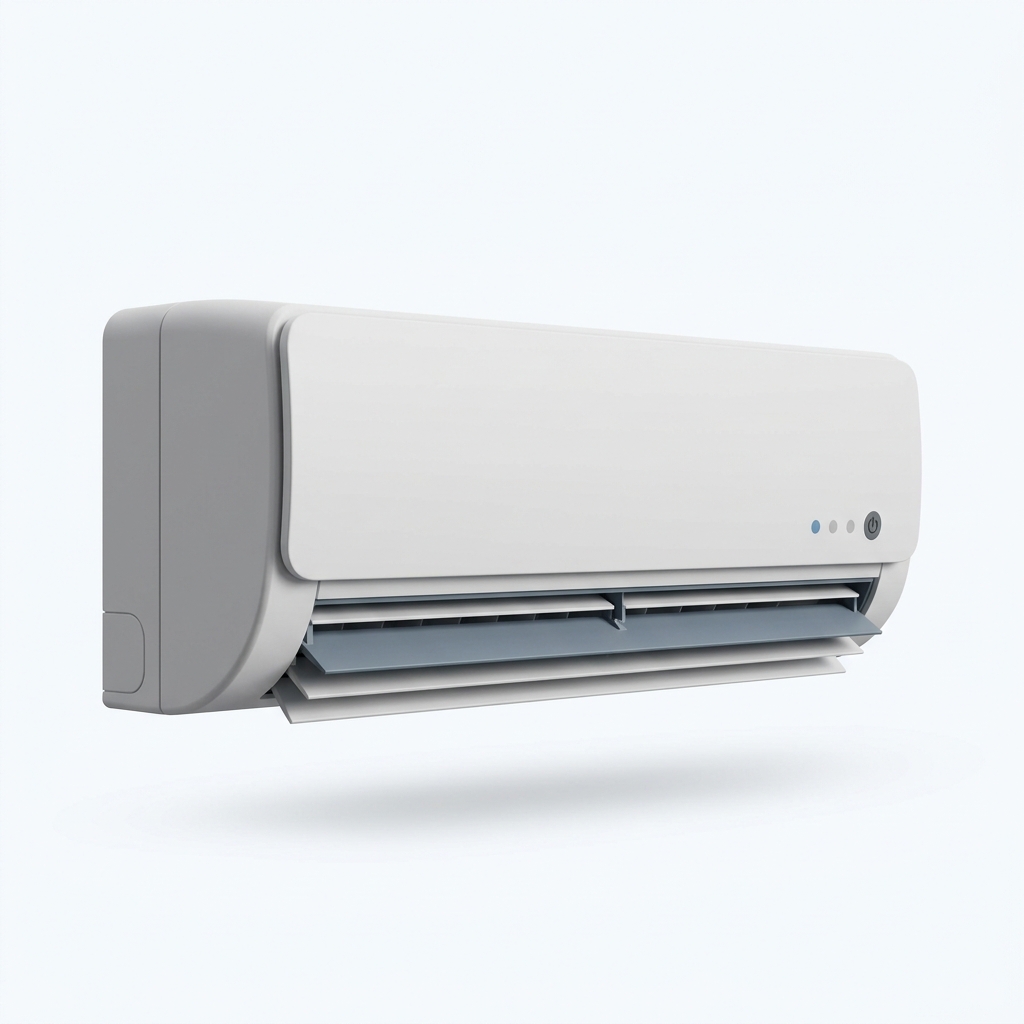
Not Cooling
Why Is My Voltas AC Not Cooling? Causes & Fixes
A Voltas air conditioner that runs but does not cool usually falls into one of a few buckets: a settings or airflow problem you can fix yourself, a voltage-protection cut that stops the compressor, or a deeper fault like low refrigerant or a compressor failure that needs a technician. Voltas inverter units are protective by design — they will quietly stop the compressor and blow room-temperature air when the mains voltage drifts out of range, sometimes flashing a voltage-protection code such as P1 or P4. A P0 code is different — it is an inverter power-module (IPM/IGBT) over-current fault that needs a technician, not a voltage problem. The quickest way to narrow it down is to check whether the outdoor unit's fan and compressor are actually running, and whether any error code is showing on the indoor display.
Updated July 2026 · Cross-referenced with Voltas service manual
Indian context
For Voltas units in India, two causes dominate 'not cooling' complaints. The first is airflow: our dust clogs the indoor filter within weeks and cakes the outdoor condenser, and a Voltas inverter starved of airflow will run without ever cooling the room. The second is voltage — Voltas markets many models as wide-range 'Adjustable Inverter' units, but during summer load-shedding and evening peaks the supply still sags enough to trip the compressor's voltage protection, so the fan blows warm air and you may see a voltage-protection code such as P1 or P4 on the display (P0, by contrast, is an inverter power-module over-current fault, not a voltage issue). Outdoor units on sun-blasted terraces or boxed against a wall cannot reject heat, which is a third common killer of cooling. Genuine gas leaks occur, typically at installation flare joints, but Voltas (a Tata company) has one of the widest and more trustworthy service networks in the country, so it is worth a proper diagnosis rather than accepting a reflexive 'needs gas'. Rule out settings, filters, the outdoor unit and voltage before spending on refrigerant.
What error Not Cooling means
A Voltas air conditioner that runs but does not cool usually falls into one of a few buckets: a settings or airflow problem you can fix yourself, a voltage-protection cut that stops the compressor, or a deeper fault like low refrigerant or a compressor failure that needs a technician. Voltas inverter units are protective by design — they will quietly stop the compressor and blow room-temperature air when the mains voltage drifts out of range, sometimes flashing a voltage-protection code such as P1 or P4. A P0 code is different — it is an inverter power-module (IPM/IGBT) over-current fault that needs a technician, not a voltage problem. The quickest way to narrow it down is to check whether the outdoor unit's fan and compressor are actually running, and whether any error code is showing on the indoor display.
Why error Not Cooling happens on a Voltas Air Conditioner
On a Voltas Air Conditioner, error Not Coolingtypically resolves to one of three root-cause categories. They’re ordered cheapest-to-verify first — start at the top and only escalate if the first cause is ruled out.
- Mechanical: blockage, obstruction, or worn moving part. A common cause across Voltas Air Conditioners in India — air filters clog and fan bearings and drain lines collect dust and sludge. Our step-by-step fix below targets this category first because it’s the cheapest to verify and resolvereports.
- Electrical: voltage spike, sensor fault, or PCB anomaly. India’s grid carries more voltage fluctuation than many appliance design tolerances assume, and a routine surge or sag can be enough to throw Not Cooling. If you’ve had recent voltage events (lights flickering, AC tripping), start your investigation here. A working stabilizer prevents this entire category.
- Software / configuration: stuck child-lock, demo-mode, or pending firmware reset.Less common but the cheapest fix when it applies — a 60-second factory reset clears it. We list this last because it’s rarely the actual cause, but check it before disassembling anything.
Safety first
Step-by-step fix
- 1
Step 1
Check the mode and set temperature
Confirm the remote is in Cool mode (snowflake icon) with the target temperature set below room temperature, and the fan on Auto or High. Rule out Fan-only and Dry modes, which do not cool the room. If the remote display is faint, change its batteries so it sends the correct command.
Pro tip: An accidental switch to Dry or Fan mode is a surprisingly common reason a Voltas AC 'stops cooling'.
- 2
Step 2
Look for an error code on the display
Check the indoor unit display for any code. A P1 or P4 means the compressor has been cut by voltage protection — go to the voltage step. A P0 is different — an inverter power-module (IPM/IGBT) over-current fault that is a technician job, not a voltage fix. Codes like F4 (compressor) or F9 (outdoor fan) point to a specific fault with its own fix. If a code is showing, follow that code's guide; if not, continue with airflow checks.
Pro tip: Cross-referencing the exact code first saves you from cleaning filters when the real problem is a tripped voltage protection or a stalled outdoor fan.
- 3
Step 3
Switch off and clean the filters
Turn the AC off at the MCB, open the indoor front flap, and remove the mesh filters. Wash them under running water if they are dusty, dry them fully, and refit. In dusty Indian cities this restores cooling more often than any other single fix — do it every 2-3 weeks in peak season.
Caution: Dry the filters completely before refitting so water does not drip onto the indoor electronics.
- 4
Step 4
Check the outdoor unit and its airflow
At the outdoor unit, confirm the fan spins when the AC calls for cooling and clear any leaves, dust or objects blocking it. Make sure it has breathing space and is not baking against a wall or in direct sun. Hose down a visibly dirty condenser coil with the power off. If the outdoor unit is silent while the indoor runs, suspect voltage protection or a compressor/PCB fault.
Pro tip: A caked condenser coil is a slow, invisible cooling killer — it does not throw a code, it just quietly stops shedding heat.
- 5
Step 5
Steady the voltage
If a P1 or P4 voltage code is showing or the outdoor unit will not start, check the outdoor MCB and any voltage stabilizer. Measure the mains with a multimeter — a healthy supply reads about 200-240 V. If it sags or spikes, fit or verify a wide-range stabilizer sized for the AC. Voltas inverter compressors resume cooling once the supply is back in range. (A P0 code is not a voltage fault — it is a power-module over-current fault for a technician, so steadying the voltage will not clear it.)
Pro tip: See our P1 and P4 guides for the full voltage-protection walkthrough, and our P0 guide for the separate power-module over-current fault.
- 6
Step 6
If it still won't cool, call a technician
If the air blows freely but never turns cold, the outdoor unit runs with no cooling, or the indoor coil keeps icing after a filter clean, the likely causes are low refrigerant from a leak, a compressor that will not start, or a control-board fault — all technician jobs needing gauges and licensed refrigerant handling. Book Voltas service and quote any code shown.
Caution: Do not attempt a DIY gas top-up, and insist on a leak test before any refill.
When to call a technician
- • The air blows freely but never gets cold, even after checking the settings, filter and outdoor unit.
- • The indoor coil keeps icing over shortly after you clean the filter — a sign of low refrigerant.
- • The outdoor compressor stays silent despite good power, a healthy stabilizer and no voltage code.
- • You suspect a refrigerant leak or a compressor fault — never handle refrigerant or open the compressor yourself.
Fixed it? Protect it next time. See an extended warranty plan for your Air Conditioner →
Common mistakes Voltas Air Conditioner owners make with error Not Cooling
These six anti-patterns turn a routine 30-minute fix into a costly repair or warranty void. Read before starting.
- Forcing a stuck door, lid, or panel. Prising open a Voltas Air Conditioner housing while it is in a fault state. Forcing it usually breaks the latch or sensor — turning a small part replacement into a full service call. If the door won’t open, run the safety-disconnect step first, then try again.
- Repeated unplug-and-replug as a “reset” ritual. Cycling power three or four times without diagnosing the underlying cause stresses the PCB and can convert a soft fault into a permanent firmware-corruption code. Reset once, observe whether the error returns immediately, then move to actual diagnosis if it does.
- Pouring water (or any liquid) into electronics-adjacent areas to flush a blockage.Even a small amount near the PCB or main wiring harness can cause permanent damage that voids warranty. The unit’s drainage paths exist for a reason; if a blockage isn’t cleared by the manual procedure, it isn’t getting cleared by improvisation either.
- Skipping the safety-disconnect step.“I’ll just check quickly” is the most expensive sentence in appliance repair. Working live on a 230V circuit (especially with a hot or wet appliance) carries real shock risk and instantly voids any warranty claim. Disconnect, wait two minutes for capacitor drain, then proceed.
- Buying counterfeit replacement parts on Amazon.in. Red flags: price below 60% of Voltas authorised price, generic packaging without a model-compatibility list, seller name that doesn’t match a known Voltas parts distributor, listings dated within the last 30 days with no reviews. Counterfeit parts often work for 2-3 weeks then fail with a different error, costing you double.
- Calling an “independent” technician for a warranty-covered unit. Indian appliances under Voltas warranty must be serviced by authorised technicians or the warranty voids permanently. Even if the warranty is expired, third-party local technicians often replace working parts to inflate the bill — verify each part swap by asking to see the failure on the old part before they install the new one.
Preventing future Not Cooling on your Voltas Air Conditioner
The fix above resolves the current instance. These five maintenance habits prevent it from coming back, specific to Voltas Air Conditioners in Indian operating conditions (hard water, voltage variability, monsoon humidity).
- Monthly: wash the air filters and clear the drain line. Hard-water deposits and everyday debris are a frequent cause of recurring Not Cooling in India, and a few minutes each month is the cheapest way to avoid a repeat.
- Quarterly: descale water-touching components. Use food-grade citric acid or a Voltas approved descaler for hard-water regions (Bangalore, Hyderabad, large parts of Maharashtra and Tamil Nadu). Skipping this in a hard-water zone shortens the life of the heating and water-touching parts.
- Run the unit through a working stabilizer. A mainline stabilizer sized for Air Conditioners is the cheapest protection against voltage-induced Not Cooling occurrences. The MCB on your distribution board is not a substitute — it trips on overload, not on under-voltage or surge.
- Decide AMC vs DIY honestly. Compare the VoltasAMC quote against what you have actually spent on service. If your unit is >5 years old and you’ve had two service calls in the last 18 months, an AMC usually pays for itself. Younger units with no service history: DIY plus stabilizer is cheaper.
- Watch monthly for early-warning signs. Unusual noise during a specific cycle phase, water spotting, mild burning smell — any of these means a service call within a week, not a wait-and-see month. Catching Not Cooling-precursor symptoms early turns a major repair into a routine maintenance visit.
If error Not Cooling returns within 30 days of completing the fix above, escalate directly to Voltasauthorised service — repeat patterns within a month indicate a deeper fault (worn bearing, failing PCB, leak that wasn’t fully identified) that surface-level repair won’t resolve. Document the dates and circumstances of each occurrence; the service centre will use this to prioritize root-cause investigation.
Frequently asked questions
Why is my Voltas AC running but not cooling?
Usually a wrong mode setting, a dust-clogged filter, a blocked or overheating outdoor unit, or a voltage-protection cut that has stopped the compressor (shown as P1 or P4; a P0 code instead points to an inverter power-module over-current fault that needs a technician). If none of those apply and the air never turns cold, low refrigerant from a leak or a compressor fault is likely, which needs a technician.
My Voltas AC shows P1 or P4 and won't cool — what does that mean?
P1 and P4 are voltage-protection codes. The inverter has cut the compressor because the mains voltage went out of the safe range, so the indoor fan keeps blowing warm air. Steady the supply — check the stabilizer and mains voltage, and fit a wide-range stabilizer if it fluctuates — and cooling resumes. Note that P0 is not a voltage code: it is an inverter power-module (IPM/IGBT) over-current fault that needs a technician. See our dedicated P0, P1 and P4 guides.
Does a Voltas AC not cooling mean it needs gas?
Not usually. Clean the filter, check the mode, inspect the outdoor unit and steady the voltage first — those free fixes solve most cases. Only if the coil keeps icing after a filter clean, or the air never cools with everything else healthy, is low refrigerant likely, and a good technician will leak-test before refilling.
How often should I service my Voltas AC in India?
Wash the filters every 2-3 weeks in heavy-use months and get a full service (coil clean, checks) once a year, ideally just before summer. Regular filter cleaning alone prevents most 'not cooling' complaints in dusty Indian conditions.
People also ask
How do I fix a Voltas AC that is not cooling?
Why does my Voltas AC blow warm air?
Related repair guides
Editor’s take
With Voltas specifically, always glance at the indoor display before you start pulling filters — because a large share of 'not cooling' cases are the inverter quietly protecting itself with a P1 or P4 voltage code, and the real fix is a stabilizer, not a service. (A P0 code is the exception — it is an inverter power-module over-current fault that does need a technician.) If there is no code, then it is the usual Indian suspects: a filter caked with dust, an outdoor unit cooking against a wall, a condenser coil no one has cleaned in two summers. Those are all free to fix and account for most complaints. Be wary of the reflexive 'needs gas' diagnosis — genuine leaks exist, but they are over-sold, and the one advantage of owning a Voltas is that the Tata service network is broad and generally honest, so you can get a proper leak test rather than a blind refill. Reserve the technician for what truly needs one: a dead compressor, a board fault, or a confirmed refrigerant leak. Check the code, check the airflow, check the voltage — in that order — and you will solve most Voltas cooling problems without spending much at all.
Same problem on other air conditioner brands
Error Not Cooling on a Voltas air conditioner is a not cooling. Other brands show the same fault under a different code — the diagnosis is similar:
Blue Star — Error E1 on a Blue Star split air conditioner signals a fault in the indoor air temperature sensor (thermistor)
Air Conditioner
Blue Star — Error E2 on a Blue Star split air conditioner indicates a fault in the indoor evaporator coil temperature sensor
Air Conditioner
Blue Star — Error E3 on a Blue Star split air conditioner indicates a fault with the outdoor condenser coil temperature sensor
Air Conditioner
Blue Star — Error E5 on a Blue Star split air conditioner indicates that the compressor overcurrent protection circuit has tripped
Air Conditioner
Blue Star — Error F3 on a Blue Star split air conditioner indicates that the outdoor fan motor has failed or is not functioning within acceptable parameters
Air Conditioner
Carrier — Error E1 on a Carrier split air conditioner signals a fault with the indoor ambient temperature sensor (thermistor)
Air Conditioner
Carrier — Error E2 on a Carrier split AC indicates a fault with the indoor evaporator (coil) temperature sensor
Air Conditioner
Carrier — Error E4 on a Carrier split air conditioner indicates a fault with the outdoor condenser temperature sensor
Air Conditioner